

In biotech, feedback is not a soft skill—it is an execution system. Every clinical decision, platform iteration, regulatory interaction, and cross-functional handoff generates signals. The speed at which those signals convert into action determines whether your company compounds learning—or drowns in debate.
High-performing biotech organizations don’t collect more feedback. They constrain feedback. They decide who gives it, when it is given, and what decisions it is allowed to influence. Without structure, feedback becomes a proxy for power: who speaks loudest, who is most senior, or who feels most threatened.
As headcount grows from 10 to 100, informal feedback loops break. What once felt like “open culture” quietly turns into Slack threads, side conversations, and delayed decisions. The cost isn’t morale—it’s velocity. Structured feedback loops turn uncertainty into momentum. Unstructured ones turn it into politics.
The Biotech Risk (If You Ignore This)
When feedback lacks a system, three dangerous patterns emerge:
Decision Drag: Every decision attracts late-stage opinions. Teams wait for consensus that never formally arrives. Experiments stall while opinions multiply.
Invisible Vetoes: Feedback becomes a soft “no.” People don’t block decisions directly—they raise concerns endlessly until momentum dies.
Trust Erosion: High performers stop contributing feedback when they see it weaponized or ignored. Low-signal voices dominate airtime.
In biotech, this compounds brutally. Delayed platform calls burn capital. Indecision around trial design extends timelines. Political feedback during fundraising fractures external confidence. Most operators misdiagnose this as a “culture issue.” It’s not. It’s a systems failure.
If feedback does not reliably produce decisions, teams learn that sharing truth is risky and slow. They adapt by protecting themselves instead of advancing the company. At that point, you are no longer scaling execution—you are scaling avoidance.
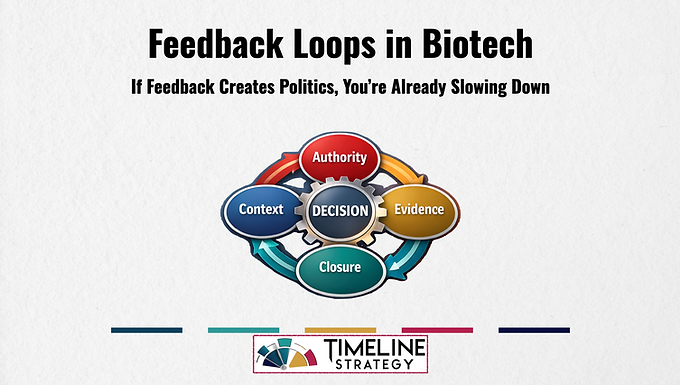
The Framework: The ACCEL Feedback Loop
To turn feedback into acceleration, install ACCEL—a closed-loop system designed for high-stakes biotech environments.
A — Authority Defined
Every feedback loop must have a single decision owner. Feedback informs decisions; it does not make them. If authority is ambiguous, feedback becomes political by default.
Rule: If no owner is named, feedback is paused.
C — Context Locked
Feedback without context creates noise. Define what type of feedback is requested:
Risk identification
Alternative options
Execution improvements
Rule: Feedback outside the defined context is logged, not debated.
C — Cadence Fixed
Feedback must arrive at a known time, not continuously. Continuous feedback equals continuous interruption.
Rule: No ad-hoc feedback on in-motion decisions unless risk exceeds a predefined threshold.
E — Evidence Required
Opinions scale poorly. Evidence scales well.
Rule: Feedback must reference data, precedent, or explicit assumptions. “I feel” is not actionable input.
L — Loop Closure
Unclosed feedback loops destroy trust.
Rule: Every feedback cycle ends with:
Decision made
Rationale stated
Feedback acknowledged (even if not used)
This turns feedback from emotional currency into operational input.
Diagnostic Exercise (CEO / Operator Test)
Run this 10-minute audit with your leadership team:
Can every team member name who owns the final decision on platform, clinical, and regulatory calls?
Do your teams know when feedback is expected vs. disruptive?
Is feedback documented, or does it live in meetings and Slack?
Do people know why their feedback was or wasn’t used?
Are the same debates repeating across quarters?
If you answered “no” to more than two, your feedback loops are leaking speed.
Insider Tip
The fastest biotech companies separate psychological safety from decision authority. Everyone can speak. Not everyone decides. When leaders overcorrect by democratizing decisions instead of inputs, they unintentionally create politics. Clarity feels strict—but it’s what creates trust.
Closing
Want to install high-velocity feedback loops inside your biotech without killing culture or speed?→ Book a Strategy Workshop.